
Travelling on the Deutsche Bahn can be a convenient and efficient way to explore the country. However, if it’s your first time, navigating the system might seem a bit daunting. Here’s a step-by-step guide to help you travel smoothly and confidently.
Table of Contents
- What is Deutsche Bahn?
- Step-by-Step Deutsche Bahn Travel Guide
- Types of Trains on Deutsche Bahn
- Understanding the Types of Tickets on Deutsche Bahn
- Why the Flexpreis Ticket is the Best Choice for First-Time Arrivals in Germany
- Where to Keep Luggage on Deutsche Bahn Trains
- Family and Small Children Compartments on ICE/IC Trains
- Useful Phrases When Taking the Train in Germany for the First Time
- Last few wise words!
What is Deutsche Bahn?

Deutsche Bahn (DB) is Germany’s national railway company, responsible for the majority of train services across the country. It operates an extensive network of regional and long-distance trains, including high-speed InterCity Express (ICE) trains that connect major cities and regions. As one of the largest and most advanced railway systems in Europe, Deutsche Bahn offers a variety of ticket options and travel services, making it a key part of public transportation in Germany. DB is known for its efficiency, punctuality, and comprehensive coverage, providing reliable travel for both domestic and international routes.
Step-by-Step Deutsche Bahn Travel Guide
1. Planning Your Journey
Before you set off, it’s essential to plan your journey:
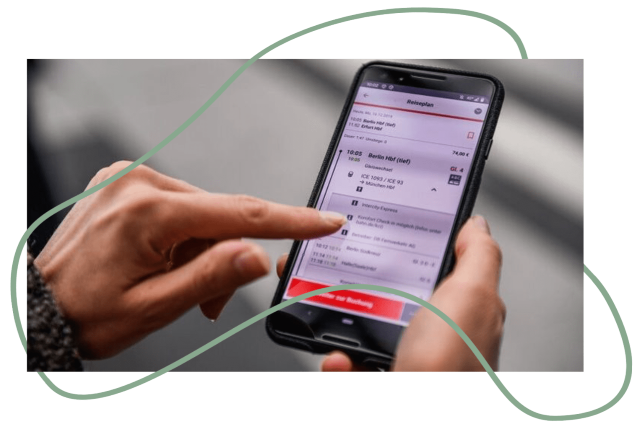
- Use Online Tools: The Deutsche Bahn website (bahn.com) and the DB Navigator app are great tools for planning your trip. Enter your departure and arrival stations, and you’ll get a list of possible routes, including transfer details and ticket prices.
- Check the Schedule: Trains in Germany are known for their punctuality, but it’s always good to check the schedule closer to your departure time for any changes or delays.
- Choose the Right Ticket: Depending on your journey, you can choose from various ticket options. For regional travel, the “Quer-durchs-Land” or “Länder-Tickets” are economical choices, offering unlimited travel in specific regions for a day. For long-distance travel, booking in advance can save you money, but be aware that these tickets are often tied to specific trains.
2. Deutsche Bahn Train Booking
You can purchase your ticket in several ways:
- Online (DB.com) or via the DB Navigator App: Buying tickets online is convenient, and you can either print your ticket or use a mobile ticket on the app. (integrate links to DB website and DB app)
- Ticket Machines: At most train stations, you’ll find self-service ticket machines that offer instructions in English. Simply select your destination, choose your ticket type, and pay using cash or card.
- Ticket Counters: For personalized service, you can buy your ticket at a ticket counter in the station, where staff can assist you in English.
3. Navigating the Train Station
German train stations can be large and busy, but with a little preparation, you’ll find your way easily:
- Find Your Platform: Your ticket or the app will indicate the platform (Gleis) from which your train departs. Follow the signs in the station to locate the correct platform.
- Pay Attention to Announcements: Even though announcements are mostly in German, key information like train delays or platform changes is also often displayed on electronic boards.
- Check the Train Composition: Long-distance trains (IC/ICE) display a train composition chart on the platform, showing where each carriage will stop. This helps you board the correct section if you have a reserved seat.
4. On the Train
Once on board, settle in and enjoy the ride:
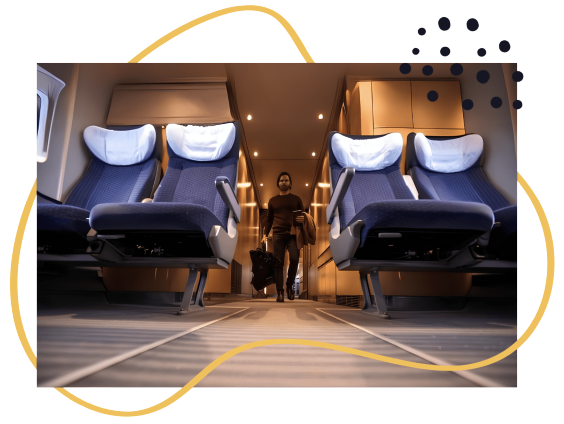
- Find Your Seat: If you have a reserved seat (which we highly recommend by the way), the carriage and seat number will be indicated on your ticket. Look for the corresponding signs above the seats. If you don’t have a reservation, find any unoccupied seat.
- Ticket Validation: If you bought a regional ticket at the station, it may need to be validated in a machine before boarding. Tickets bought online or at the counter are usually pre-validated.
- Ticket Inspection: Conductors regularly check tickets on board. Have your ticket ready, along with your ID, if required.
5. Transfers and Delays
If your journey involves changing trains:
- Allow Time for Transfers: Make sure to give yourself enough time between trains, especially if you’re unfamiliar with the station layout.
- Follow Signs for Transfers: Look for signs pointing to “Umsteigen” (transfer) and follow them to your next platform.
- Handling Delays: In case of delays, check the DB Navigator app or the information boards in the station for updates. If you miss a connection due to a delay, Deutsche Bahn typically allows you to take the next available train without additional cost.
6. Arriving at Your Destination
Once you reach your destination:
- Check for Connections: If your journey continues by bus or tram, look for the signs leading to the appropriate stops, or consult the DB Navigator app for further directions.
- Leaving the Station: Larger stations often have multiple exits. Signs for “Ausgang” (exit) will guide you out.
Types of Trains on Deutsche Bahn
Deutsche Bahn operates several types of trains, each catering to different travel needs:
- ICE (InterCity Express): These are the fastest trains, connecting major cities across Germany and neighbouring countries. They offer high-speed travel with comfortable amenities, making them ideal for long-distance journeys.
- IC/EC (InterCity/EuroCity): Slightly slower than ICE, these trains also cover long distances but at a lower price point. The EuroCity trains connect Germany with other European countries.
- RE (Regional Express): These regional trains connect cities within a specific region. They make fewer stops than local trains and are a good option for medium-distance travel.
- RB (Regionalbahn): RB trains are local trains that stop at all stations along their routes, connecting smaller towns and cities within a region.
- S-Bahn: These suburban trains operate within metropolitan areas, connecting city centres with surrounding suburbs and towns. They’re great for short commutes and frequent stops.

Understanding the Types of Tickets on Deutsche Bahn
When travelling on the Deutsche Bahn, it’s important to choose the right ticket that suits your travel needs and budget. Here’s a breakdown of the different types of tickets available:

1. Super Sparpreis (Super Savings Fare)
- What it is: The Super Sparpreis is the lowest-priced option for long-distance travel. It offers the same benefits as the Sparpreis, but at even lower prices. However, it is also tied to a specific train and is non-refundable.
- Best for: Travelers looking for the cheapest option and who are certain about their travel plans.
- Refunds: Super Sparpreis tickets are non-refundable and cannot be exchanged.
- Prices: Super Sparpreis tickets are the most budget-friendly option available, often offering significant savings compared to Flexpreis and Sparpreis tickets. Prices vary depending on the route and booking time, with the lowest prices available well in advance of the travel date
2. Sparpreis (Savings Fare)
- What it is: Sparpreis tickets are discounted tickets available for long-distance trains like ICE (InterCity Express) and IC (InterCity). These tickets are often significantly cheaper than Flexpreis tickets, but they are tied to a specific train and departure time.
- Best for: Budget-conscious travelers who have a fixed travel plan.
- Refunds: Sparpreis tickets are partially refundable up to the day before travel for a fee, but they become non-refundable on the day of travel.
- Prices: Sparpreis tickets are usually much cheaper than Flexpreis tickets, with prices varying depending on how early you book and the popularity of the route. Discounts may also apply for children or BahnCard holders. However, prices can increase as the departure date approaches or if demand is high.
3. Flexpreis (Flexible Fare)
- What it is: The Flexpreis ticket offers the most flexibility, allowing you to travel on any train between your selected departure and arrival stations on the date of your ticket. You can also change your travel time without needing to worry about missing a specific train.
- Best for: Travellers who prefer flexibility and may need to adjust their plans.
- Refunds: Flexpreis tickets are refundable before the first day of validity, but a fee may apply. After the journey has started, refunds are generally not available.
- Prices: The Flexpreis is typically the most expensive option among the available fare types, reflecting its high level of flexibility. Prices can vary depending on the route, class of service (1st or 2nd class), and whether you’re purchasing a one-way or round-trip ticket. Discounts may be available for children, seniors, or those with specific travel cards.
4. Länder-Tickets (Regional Day Tickets)
- What it is: Länder-Tickets allow unlimited travel within a specific federal state (or a group of states) on regional trains (RE, RB, S-Bahn) for a day. These tickets are valid for up to five people travelling together, making them great for groups.
- Best for: Regional travel within one state or neighbouring states, especially for day trips or group travel.
- Refunds: Länder-Tickets are non-refundable after purchase.
- Prices: Länder-Tickets are priced based on the specific state or group of states and the number of travellers. They offer great value for group travel, with a set price for up to five people. Prices are typically much lower than long-distance fares, making them an economical choice for regional travel.
5. Quer-durchs-Land-Ticket (Cross-Country Ticket)
- What it is: This ticket allows unlimited travel on regional trains across all of Germany for one day. It’s valid from 9:00 AM on weekdays (midnight on weekends) until 3:00 AM the next day.
- Best for: Budget travelers exploring multiple regions within a single day using regional trains.
- Refunds: Quer-durchs-Land-Tickets are non-refundable after purchase.
- Prices: The Quer-durchs-Land-Ticket is an affordable option for cross-country travel on regional trains, with a flat rate for one person and additional costs for up to four more passengers. Prices are fixed, offering significant savings for travellers covering large distances within one day.
6. BahnCard Discounts
- What it is: A BahnCard is a discount card that can be purchased for a year and offers discounts on most Deutsche Bahn tickets. There are different types of BahnCards, such as BahnCard 25 (25% discount), BahnCard 50 (50% discount), and BahnCard 100 (unlimited travel).
- Best for: Frequent travellers who use Deutsche Bahn regularly.
- Refunds: BahnCard purchases are typically non-refundable, though there are exceptions for certain situations.
- Prices: BahnCard prices vary depending on the type and duration of the card. While there is an upfront cost, the savings on ticket prices can quickly add up, especially for frequent travellers. BahnCard 25 and 50 offer good value for those who often travel, while BahnCard 100 is ideal for very frequent travellers.

7. Group Tickets
- What it is: Group tickets offer discounts for groups of six or more people travelling together. These tickets are available for both regional and long-distance travel and need to be booked in advance.
- Best for: School trips, family outings, or any group travel.
- Refunds: Group tickets are usually non-refundable, but check specific conditions at the time of purchase.
- Prices: Group tickets provide significant savings compared to individual tickets, with prices depending on the group size and travel distance. Discounts increase with the number of people in the group, making them a cost-effective option for large groups.
8. Deutschland Ticket
- What it is: It is a monthly subscription pass costing €58 per month. It allows unlimited travelling on all the regional buses, trains, trams, and S-Bahn across Germany.
- Best for: Commuters travelling regularly between regions or cities.
- Refunds: As it is a subscription pass, it is non-refundable. However, you can cancel the subscription whenever you want to before starting of the next month.
- Prices: It has a fixed price of €58 per person. It has to be bought individually unlike other tickets.
Why the Flexpreis Ticket is the Best Choice for First-Time Arrivals in Germany
When you’re arriving in Germany by plane and planning to take a train from the airport, it’s wise to consider the Flexpreis ticket, even if it costs more than other options. Unlike the Sparpreis or Super Sparpreis tickets, which are tied to specific trains and departure times, the Flexpreis ticket offers you the flexibility to take any train on your route on the day of travel.
Why Flexibility Matters After a Flight
- Flight Delays: Airlines are notorious for delays, and if your flight is late, a Sparpreis or Super Sparpreis ticket tied to a specific train could be wasted. With a Flexpreis ticket, you can simply catch the next available train without worrying about missing your connection.
- Immigration and Baggage Collection: The time it takes to get through immigration and collect your luggage can be unpredictable, especially at busy airports. A Flexpreis ticket removes the stress of rushing through these processes to make it to a specific train.
- Peace of Mind: After a long flight, the last thing you want to worry about is train schedules. The Flexpreis ticket gives you the peace of mind to take your time and travel at your own pace.
Important — Date of Travel: Keep in mind that your landing date might not be the same as your departure date if you’re travelling across time zones. With a Flexpreis ticket, you’re not restricted to a specific day, giving you the flexibility to travel on the correct date, regardless of any schedule changes.
Where to Keep Luggage on Deutsche Bahn Trains
When travelling on Deutsche Bahn trains, it’s essential to know where you can store your luggage safely and conveniently. Here’s a guide to help you:
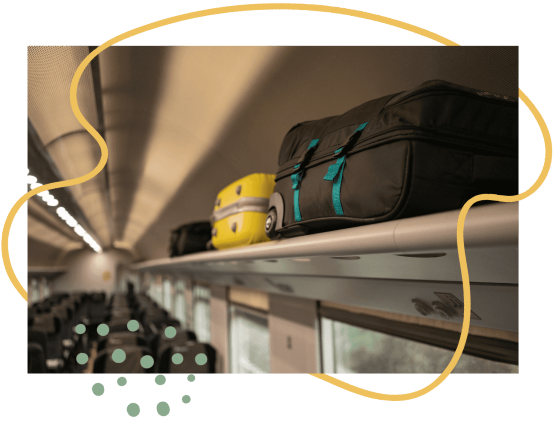
- Overhead Racks: On most trains, especially ICE, IC, and EC trains, there are overhead racks above the seats where you can place smaller bags and suitcases. These are similar to the overhead bins on airplanes but open and accessible throughout the journey.
- Luggage Compartments: For larger suitcases, many trains have dedicated luggage compartments near the doors or at the ends of each carriage. These areas are spacious enough to store big bags, but it’s a good idea to keep an eye on your belongings, especially on busy routes.
- Under the Seats: If your luggage is small enough, you can slide it under your seat. This is especially useful for carry-on-sized bags or backpacks.
- Between Seats: Some trains have space between the back-to-back seats, where you can wedge medium-sized bags. It’s a convenient option if the overhead racks are full.
- Designated Luggage Areas: On some ICE and IC trains, there are designated luggage areas within each carriage. These are often marked with luggage icons and offer secure storage with straps to hold your bags in place.
Tips for Luggage Storage
- Label Your Luggage: Always have a visible label on your luggage with your contact details, just in case it gets misplaced.
- Keep Valuables Close: Keep your valuables, such as passports, electronics, and money, in a smaller bag that you can keep with you at your seat.
By knowing where to place your luggage, you can enjoy a comfortable and hassle-free journey on Deutsche Bahn.
Family and Small Children Compartments on ICE/IC Trains
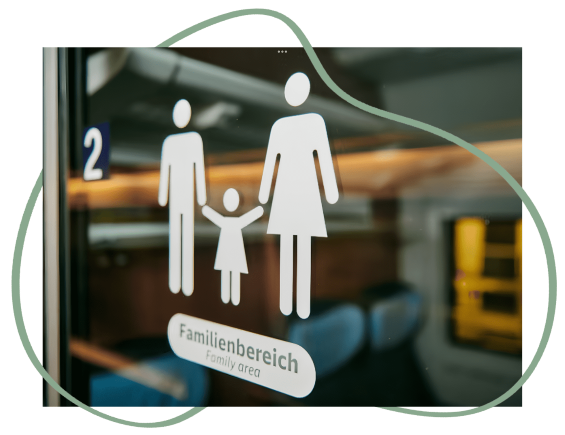
ICE and IC trains offer special family compartments and small children’s compartments designed to make travel more comfortable for families. These compartments are equipped with extra space for strollers, play areas, and seating arrangements that allow families to sit together in a quieter, more relaxed environment. Booking these compartments is the best option when travelling with small children, as it provides a designated area where kids can play and parents can tend to their needs without disturbing other passengers. It also offers a safer and more enjoyable experience for everyone, ensuring a smoother journey for both parents and little ones.
Useful Phrases When Taking the Train in Germany for the First Time
Navigating the Deutsche Bahn system can be easier if you know a few key phrases in German. Here are some useful ones to help you get around:

- Buying Tickets:
- “Ich hätte gerne ein Ticket nach [destination].” – “I would like a ticket to [destination].”
- “Hin- und Rückfahrt oder nur Hin?” – “Round trip or just one way?”
- At the Station:
- “Wo ist der Bahnsteig für den Zug nach [destination]?” – “Where is the platform for the train to [destination]?”
- “Wann fährt der nächste Zug nach [destination]?” – “When does the next train to [destination] leave?”
- “Gibt es Verspätungen?” – “Are there any delays?”
- On the Train:
- “Ist dieser Platz frei?” – “Is this seat free?”
- “Kann ich hier aussteigen?” – “Can I get off here?”
- “Wann kommen wir in [destination] an?” – “When do we arrive in [destination]?”
- Asking for Help:
- “Können Sie mir bitte helfen?” – “Can you please help me?”
- “Ich spreche nicht gut Deutsch.” – “I don’t speak German well.”
- “Können Sie das bitte wiederholen?” – “Can you please repeat that?”
5. Understanding Announcements:
-
- “Der Zug hat eine Verspätung von [number] Minuten.” – “The train is delayed by [number] minutes.”
- “Der Zug endet hier.” – “The train terminates here.”
- “Nächster Halt: [station name].” – “Next stop: [station name].”
6. Miscellaneous:
-
- “Gibt es eine Verbindung zu [destination]?” – “Is there a connection to [destination]?”
- “Ich muss den Zug wechseln.” – “I need to change trains.”
Last few wise words!
- Plan Ahead: If you have a fixed schedule, booking a Sparpreis or Super Sparpreis ticket in advance can save you money.
- Consider Flexibility: If your plans are uncertain, a Flexpreis ticket might be worth the extra cost for the peace of mind it offers.
- Use a BahnCard: If you will be travelling frequently, investing in a BahnCard can pay off quickly with the discounts it provides.
Understanding these ticket options will help you make an informed decision and ensure a smoother, more cost-effective journey on the Deutsche Bahn.
About the Author: Nidhi Krümpelmann (Raval)
